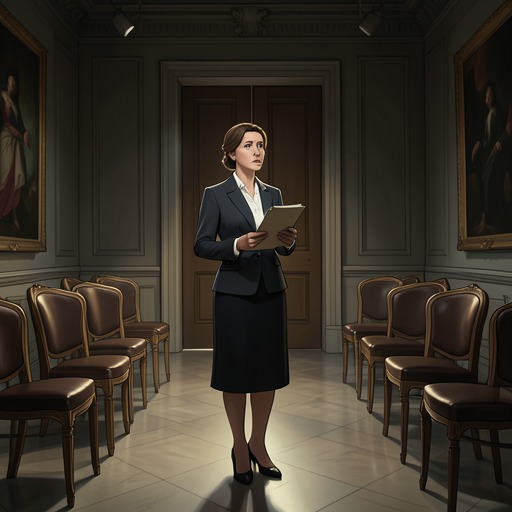
The Children's Uncle
The Turn of the ScrewThe Children’s Uncle is the children’s guardian and the employer who appoints the governess at Bly, but his defining presence in the story is his absence. He transfers responsibility for his orphaned nephew and niece to others, then forbids the governess to appeal to him, complain, or write. The resulting distance turns his authority into both a source of security and a barrier: those facing the household’s crisis repeatedly consider calling on him, while the governess believes that doing so would violate the terms on which she accepted the post and expose her to his contempt.
Identity and Background
The Children’s Uncle is a bachelor in the prime of life, described in the account of his hiring of the governess as handsome, bold, pleasant, off-hand, gay, and kind. The governess, a young woman from a poor country parson’s family, encounters him in his imposing London house after answering his advertisement. She imagines him as rich and fashionable, surrounded by objects gathered through travel and hunting, and understands his manner toward her as gallant and generous: he presents the appointment as a favor for which he will be grateful to her.
His family responsibilities arose after the deaths of the children’s parents in India. Their father, his younger brother, had been a military man and had died two years before the appointment. The uncle was left guardian to a small nephew and niece, with practically no other relations to share the burden. By the account given to the governess, he was a solitary man without the right experience or much patience for children; their care had been a worry, and his own handling of it had included blunders. The description makes his delegation understandable without removing its consequences: he pities the children and takes practical steps for their comfort, yet does not undertake their daily care himself.
Delegating the Children’s Care
The uncle sends the children to Bly, the family’s country home, which he regards as healthy and secure. He places them with people he considers reliable, gives up some of his own servants to wait on them, and visits when his other affairs allow. Mrs. Grose, formerly his mother’s maid, is made housekeeper and temporarily supervises Flora; she is fond of the girl despite having no children of her own. The uncle expects the governess, once appointed, to hold supreme authority over the household’s education and care.
The arrangements extend to Miles as well as Flora. Miles has been sent to school while still young, and the uncle expects him to return to Bly for the holidays. That placement follows the death of the earlier young woman who had cared for both children. She had looked after them well and was considered respectable; after her death, Miles’s school became the available solution, while Mrs. Grose did what she could for Flora. The uncle’s choices thus supply the household with care and structure, but depend on successive women and institutions rather than on his presence.
The No-Contact Condition
The governess’s appointment carries an unusually severe restriction. The uncle tells her that she must never trouble him—not appeal, complain, or write about anything. She is to meet all questions herself, receive money from his solicitor, take over the entire responsibility, and leave him alone. Other applicants had been frightened away by these terms. The governess accepts them, and the uncle, delighted and relieved, takes her hand and thanks her for the sacrifice. She feels rewarded by the moment, but the arrangement is settled on the understanding that she will not seek his help.
He does not see her again after the appointment. That absence is more than a biographical detail: it is the practical condition under which the governess must exercise authority at Bly. She can receive funds through his solicitor, but the source account gives her no direct channel to the employer when decisions become urgent. His delegation therefore has two sides. It grants her command of the household, yet also isolates her from the person who might otherwise be asked to intervene.
Authority and the Crisis at Bly
As the danger to the children becomes pressing, Mrs. Grose concludes that their uncle ought to help and take them away. The governess immediately rejects the prospect of asking him to visit. She imagines that he would deride her, find her breakdown amusing, and hold her in contempt for abandoning her earlier resolve to keep to their terms. She tells Mrs. Grose that if she appeals to him on her behalf, she will leave both him and Mrs. Grose at once. The threat shows how thoroughly the original condition has become part of the governess’s sense of duty and pride, even when she believes the circumstances demand outside help.
The uncle’s silence also becomes a point of pressure in her exchanges with Miles. When Miles asks whether his uncle cares about the way he is behaving, the governess answers that she does not think he cares much. She recognizes that this answer sacrifices the employer’s standing, but judges the sacrifice venial because everyone at Bly has already been left to bear so much. Miles then asks whether the uncle could be made to care. The question turns the absent guardian into a possible audience for the boy’s conduct and reveals that the uncle’s distance may be challenged, even if the governess remains bound by the terms of her appointment.
Competing Routes to the Uncle
Flora’s departure becomes another struggle over access to the guardian. The governess imagines that Flora will present her to the uncle as the lowest sort of person and thereby get rid of her. She recognizes that the uncle thinks well of her, but finds an irony in that apparent esteem: he has shown it by imposing a condition that prevents her from seeking his support. In the governess’s reading, the child’s grievance is not merely a private quarrel; it is a means of bringing the case before the employer on terms favorable to Flora.
The governess nevertheless proposes that Mrs. Grose take Flora away from Bly and straight to her uncle. She insists that the journey should separate the girl from the household and, most particularly, from herself. When Mrs. Grose worries that Flora will go only to tell on the governess, she answers that the removal would also leave her with a remedy: Mrs. Grose’s loyalty and Miles’s. The proposed appeal is therefore indirect. The governess will not ask the uncle for help herself, but she is willing to send Flora to him, accepting that the child may speak against her while treating the separation as necessary to the plan she has formed.
The uncle’s potential involvement is also delayed by the governess’s hope that Miles will speak. She recalls that he sat with her for two hours in the firelight and silence, seeming on the verge of making an opening, but said nothing about his sister’s condition or absence before they parted for the night. Although she is prepared for Flora to be taken to her uncle, she does not consent to his seeing Miles until the boy has been given a little more time. She wants a day or two in which to bring Miles into the matter and believes he may then be on her side. The guardian’s possible arrival thus remains entangled with the governess’s hope for a confession that never comes in this episode; his authority is invoked as a solution, a threat, and a prospective judge, but he remains offstage.